
India is established to harvest history foodgrains in the 2021-22 crop calendar year (July-June), many thanks to a new substantial in the output of rice, wheat, maize and pulses, the government explained on Wednesday. The report production of foodgrains, which has been mounting repeatedly each and every year given that 2016-17, has served India to be among the top 10 agricultural generate exporters in the globe. At the similar time, the food stuff subsidy, far too, has been soaring each individual 12 months with the surplus receiving distributed between the bad men and women to guarantee food security.
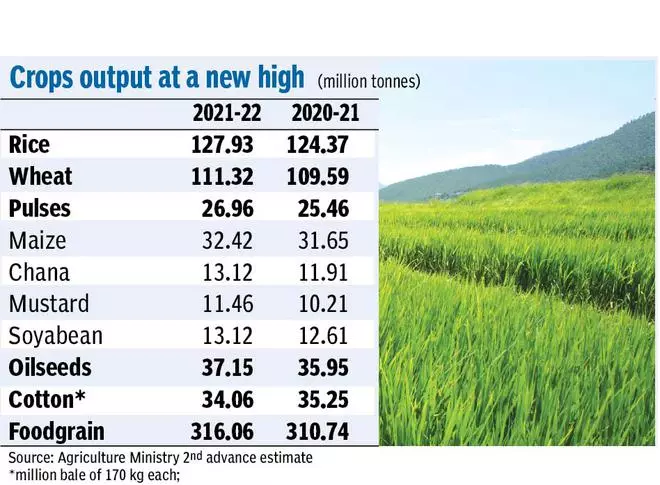
Total output of foodgrains is believed to be 316.06 million tonnes (mt) this calendar year, comprising 153.54 mt from the kharif time and 162.53 mt from the rabi period, the Agriculture Ministry said releasing the next advance estimates of crops output.
Although the advancement in the kharif output is estimated at virtually 2 per cent, in the case of rabi-grown foodgrains, the output is believed to improve at 1.5 for every cent. In general, generation is up 1.7 for each cent from the previous 12 months.
“Growth in kharif and rabi output displays that there is scope in improving creation underneath maize, though a lower in output of rice and wheat might be attractive taking into consideration the demand from customers and offer predicament in equally these commodities,” mentioned NB Singh, an agriculture economist. The stability has to be managed by crop arranging by taking States into self-confidence, he explained and cited the new instance of Telangana exactly where the State govt motivated farmers to shift to maize from paddy in the existing rabi year.
Crop-intelligent output
The most recent estimates demonstrate that wheat generation is very likely to be 111.32 mt this year, up by 1.6 for every cent from previous year’s 109.59 mt, despite a fall in acreage. Rice output has been pegged at 127.93 mt – 109.54 mt in kharif and 18.39 mt in rabi – and it is up by 2.9 for each cent from very last year’s 124.37 mt.
Maize creation is probable to go up by 2.4 per cent to 32.42 mt and that of chana by 10.2 per cent to 13.12 mt . Over-all, pulses output is established to maximize by 5.9 per cent to 26.96 mt from 25.46 mt.
Having said that, there are crops like jowar, bajra, ragi, tur and moong the place the creation is approximated to fall, however marginally. This is not excellent for the nutri-cereals sector as the governing administration has been pushing for more crops underneath this class, Singh mentioned.
Tur generation is pegged at 4 mt, down from 4.32 mt last calendar year while moong is witnessed at 3.06 mt from 3.09 mt. Jowar manufacturing is probably to fall to 4.31 mt from 4.81 mt, bajra to 9.22 from 10.86 mt and ragi to 1.67 mt from 2 mt.
Oilseeds output up
Backed by a strong output in mustard, the total production of oilseeds is projected at 37.15 mt, up from 35.95 mt past calendar year. Groundnut generation is very likely to be 9.86 mt from 10.24 mt last 12 months, soyabean at 13.12 mt towards 12.61 mt final year and mustard at 11.46 mt against 10.21 mt in 2020-21.
Sugarcane production is probably to be 414.04 mt, up from 405.4 mt final yr, though cotton output has been pegged at 34.06 million bales (every 170 kg), down from 35.25 million bales.. Jute manufacturing has been estimated to maximize to 9.17 million bales (180 kg every) from 8.95 million bales, the ministry reported.
Published on
February 16, 2022


More Stories
5 Unconventional Business Services That Could Revolutionize Your Industry
Revolutionizing Business Services: Innovative Strategies for Growth and Efficiency
Creative Adventures on Wheels: Your Ultimate Bus Inquiry Guide